November 7, 2026
Five leadership lessons from rural practice
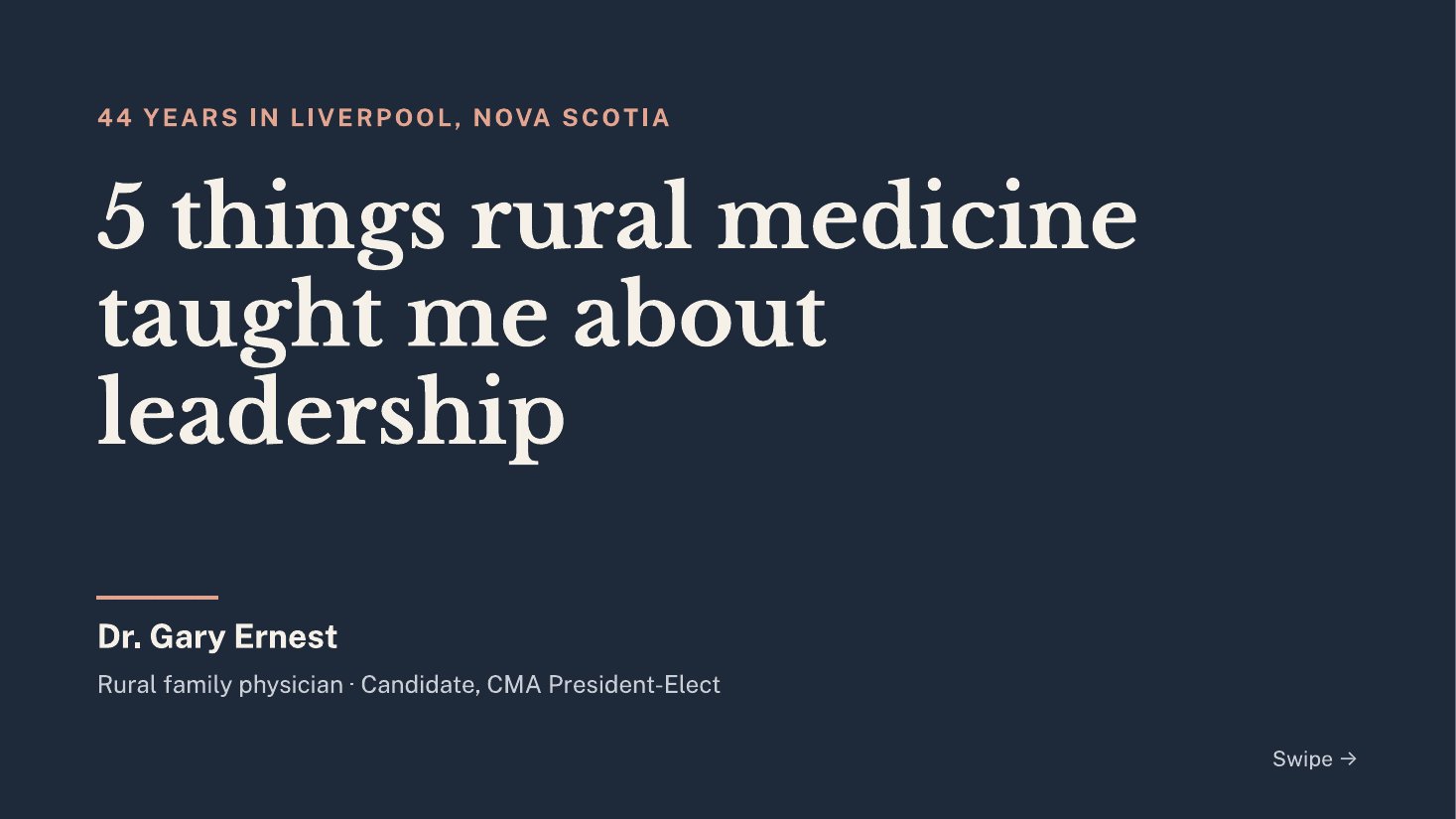
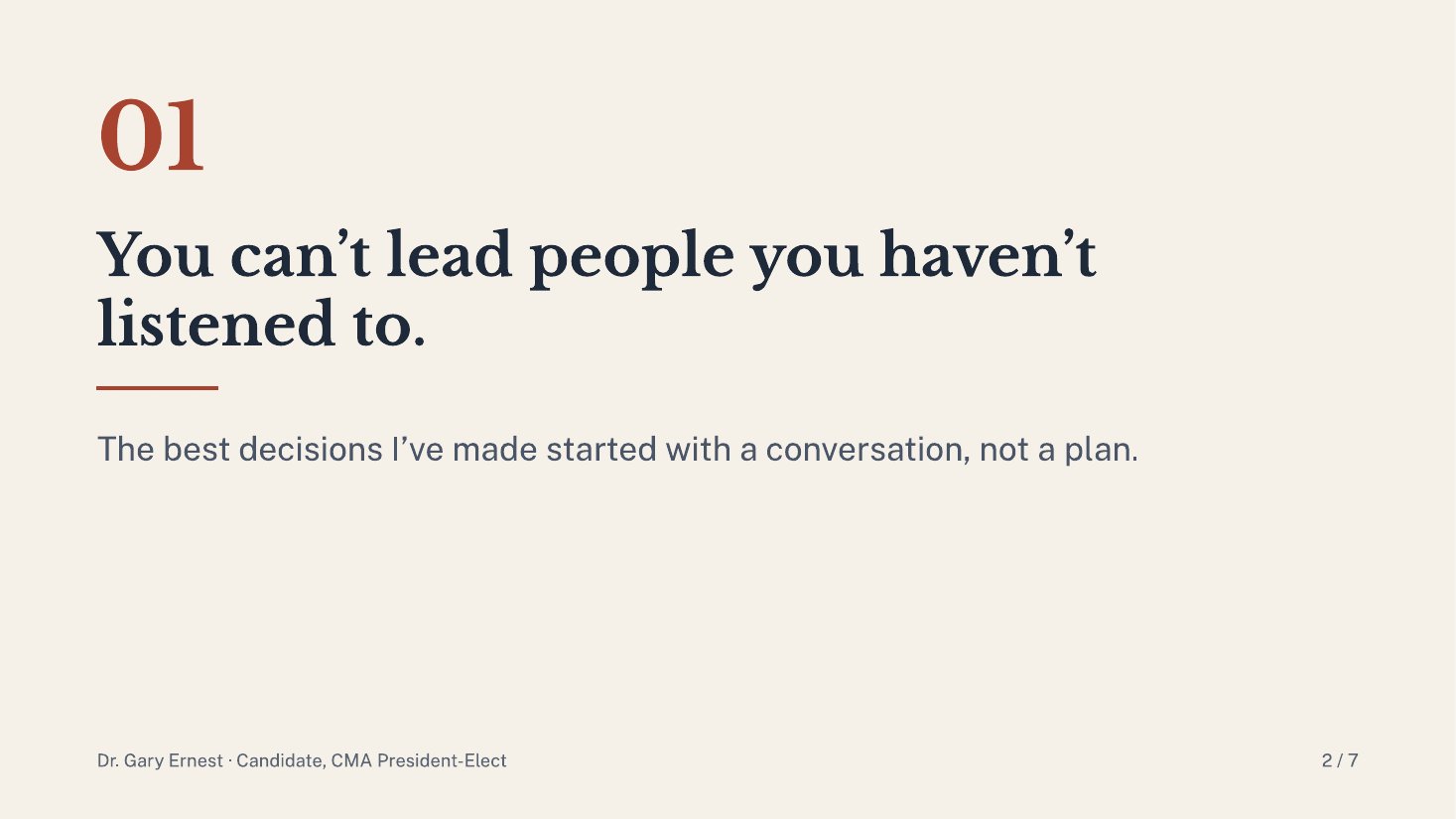
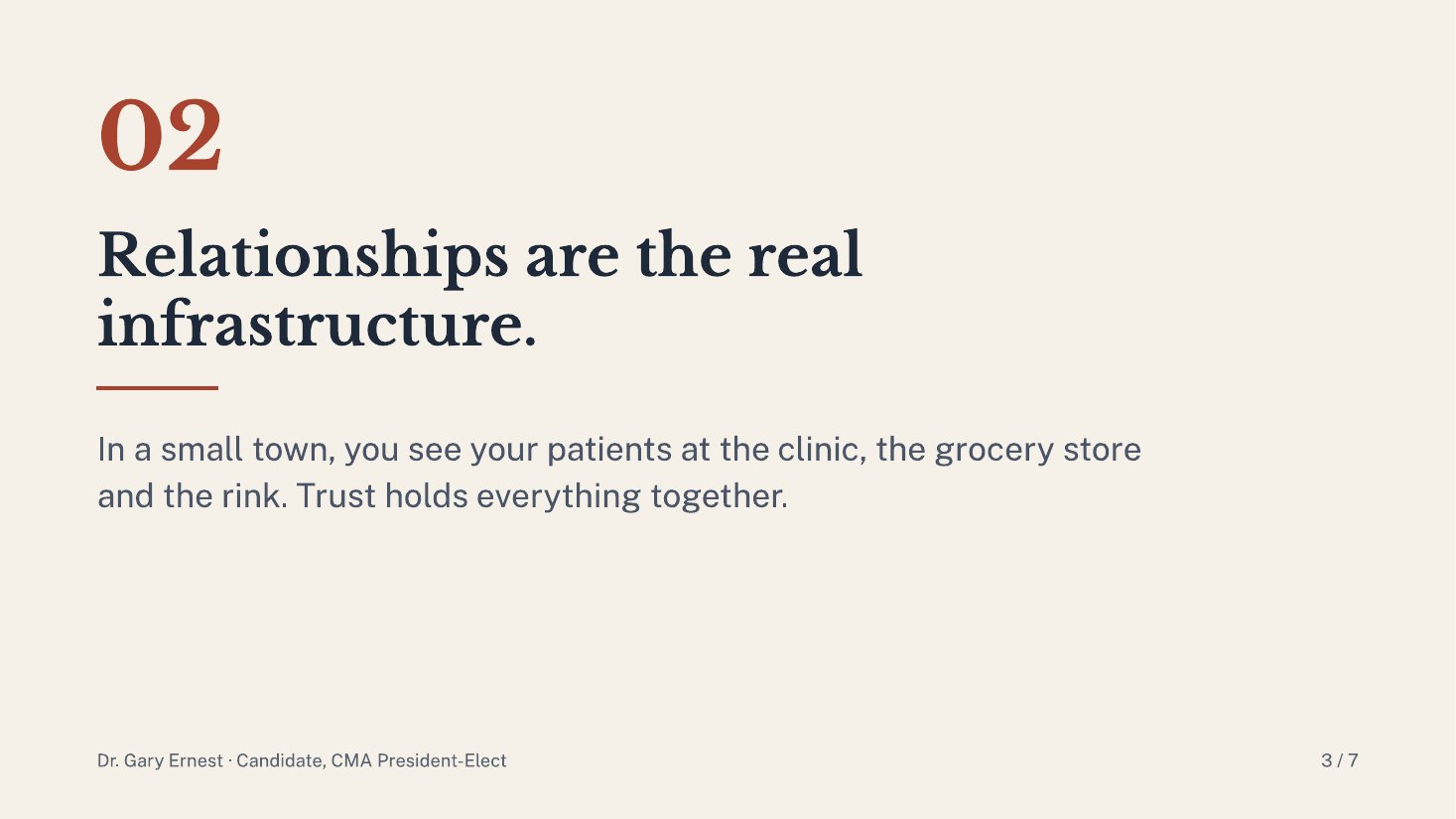
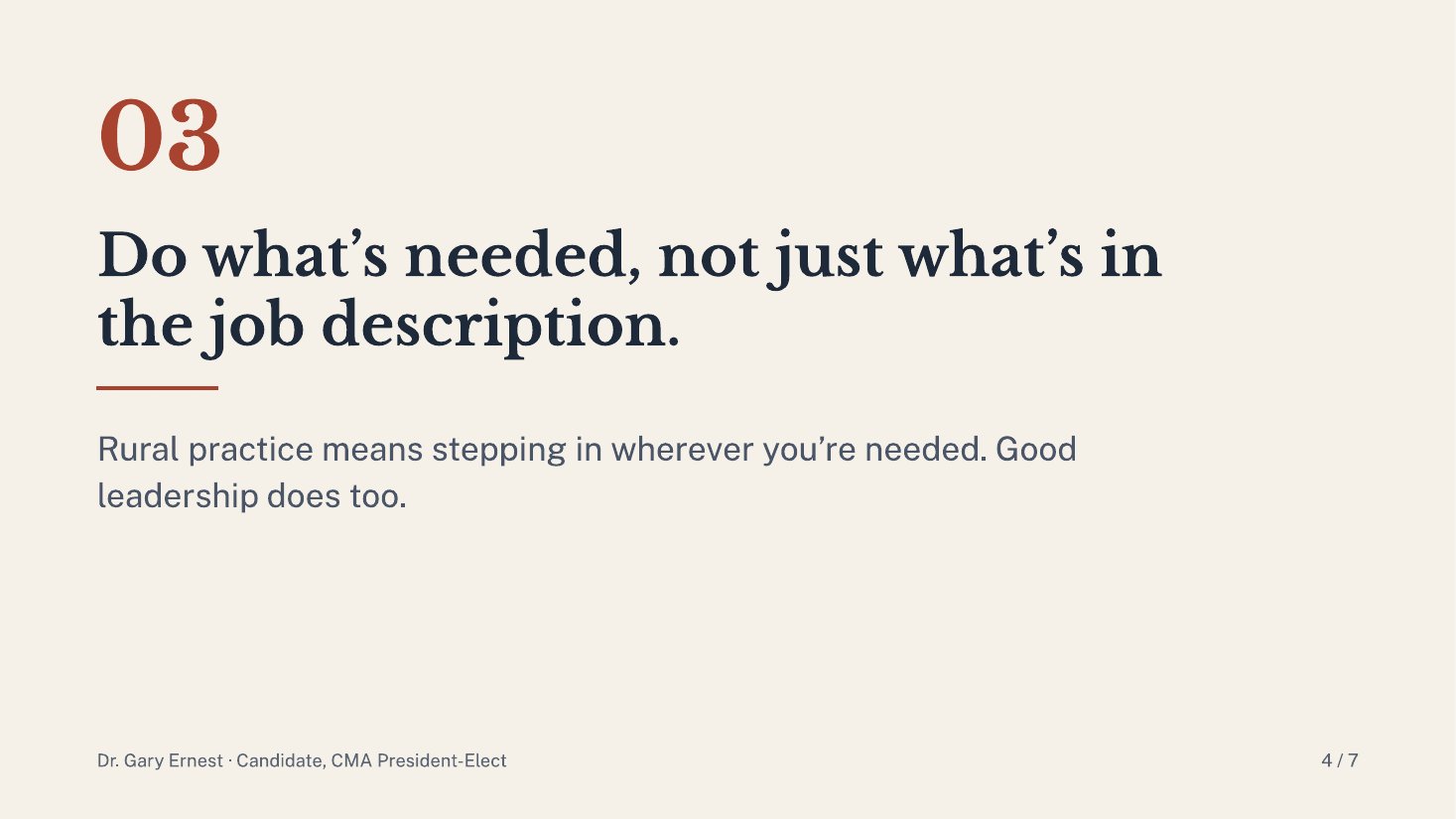
In medicine, you can't treat a patient you haven't listened to. You need the whole picture: their past, their present, and what's really keeping them up at night.
After 44 years in practice, I've found leadership works the same way. These are five lessons from rural practice that shape how I'd lead the CMA.
Swipe to see all 7 slides →
November 3, 2026
Why I went back to school to study physician burnout
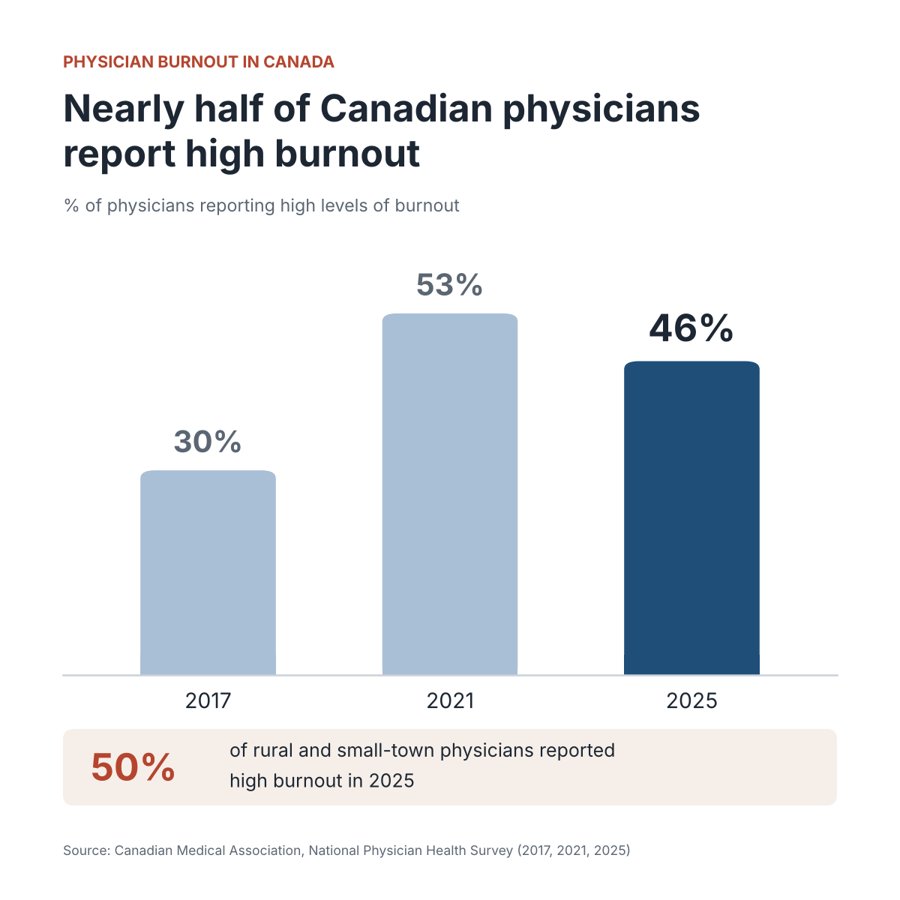
46% of Canadian physicians reported high levels of burnout, according to the 2025 National Physician Health Survey. This is an improvement compared to the 53% reported in the 2021 survey, but still represents an alarming problem.
These numbers aren't just about how doctors feel. They show up in clinic closures, specialist wait lists, reduced operating room capacity and rural emergency department closures. They influence both access to and quality of care.
Four years ago, at an age when most of my colleagues had retired or were thinking about it, I went back to school…again. I had spent decades in medical leadership, watching talented colleagues burn out, and I wanted to understand what was driving it and what actually could help. I entered a full-time doctoral program while maintaining my practice, making leadership and physician burnout the focus of my studies and thesis research. I developed an analytic framework that can identify leaders at risk of burnout or in its early stages, and that can be used to design preventive or mitigative strategies.
This work has changed how I see our profession, and it has shaped how I think about the challenges that physicians and our Canadian health care system currently face.
November 1, 2026
What hasn't changed in 44 years of house calls
Since deciding to run for CMA President-Elect, I've found myself doing something I rarely make time for: looking back.
My colleagues know how easy it is to forget to remember the years that have passed, whether it's the personal learning and growth, the systems that have evolved, the tech that has changed the day-to-day, or the lows and highs along the way.
Driving home last night from a house call, I was struck by what hasn't changed.
I started doing house calls when I began my practice in 1982. It gave me a way to care for those who couldn't easily get to the clinic, often those who were elderly, unwell or living with disabilities. They've always been one of the most rewarding parts of my practice, and are always deeply appreciated. A visit never fits into ten minutes, and there's the drive on top of it. But seeing patients where they live, in their own space and comfort, tells you things an exam room can't.
Last night's visit was to a small options home for adults with intellectual disabilities. Many of the residents need a great deal of support day to day, and the staff provide it with remarkable care. They always have.
Forty-four years on, that part of the work still matters to me as much as it did on my first visit.
October 29, 2026
Why this matters so much to me
A few weeks ago, I shared that I am running for President-Elect of the Canadian Medical Association. Thank you to everyone who reached out. Today I want to tell you why this matters so much to me.
For 44 years (and counting), I have practised full-scope family medicine in Liverpool. I've delivered babies, worked in the ER, made house calls, and cared for families across generations. I love this work. I have also watched too many colleagues give so much, in systems that made the job harder than it needed to be. I have seen how detrimental this can be to our profession, to our mental and physical health, and to patient care.
This is largely what has led me to spend the last several years researching physician leadership and burnout in physician leaders for my doctorate. One finding stayed with me: we cannot (and will not) fix system problems by putting the burden on individual physicians. As President of Doctors Nova Scotia, Chief of Staff at Queens General Hospital, and as a member of CMA's General Council across three decades, I have also seen what is possible when physicians work together.
Voting runs from November 18 to December 2. Every CMA member in Nova Scotia has a vote. I'd be honoured to have yours.
What is one thing you'd like the CMA to focus on? I'd really like to hear from you. Send me a message →
October 10, 2026
I'm running for CMA President-Elect
I'm excited to announce that I'm running to represent Nova Scotia as the next Canadian Medical Association President-Elect for 2027.
I bring over 40 years of experience in medicine, four decades of leadership, and one commitment: healthier physicians and healthier Canadians.
I have had the privilege of practising rural family medicine while serving in leadership roles at the local (hospital), zonal, provincial and national levels. Those experiences, and my recent doctoral research on physician leadership and burnout, have shaped how I see the future of our profession and of the health care system.
My priorities:
- Strengthen physician leadership: equip physicians to lead effectively in increasingly complex systems, with greater emphasis on conflict management, mental health, communication and relationship building.
- Build a healthier medical culture: create environments grounded in psychological and cultural safety, respect, collaboration, accountability, diversity and inclusion.
- Make physician well-being a system responsibility: recognize that sustainable physician well-being cannot be achieved by asking individuals to adapt indefinitely to systems that create unnecessary demands and barriers.
- Rebuild trust through collaboration: bring physicians, patients, health professionals, employers and governments together to develop practical, evidence-informed solutions to Canada's health care challenges.
- Champion innovation and technology that improves care: advance and scale practical solutions that improve access for patients, reduce friction in the system, and give physicians more time to provide care.
The Canadian Medical Association has set an ambitious vision for 2040: a sustainable and accessible health care system, a healthier medical culture, and equal opportunity for Canadians to achieve good health. My commitment is to bring experience, knowledge and relationships together to help advance that vision.